• What We Do
    • Wealth Counseling
    • Investment Advisory Services
  • Who We Are
    • Our Team
    • Research Roundtable
  • How We Invest
    • Our Fiduciary Pledge
    • Investment Approach
    • Questions To Consider
    • Our Transparent Approach
  • Insights and Research

Insights and Research

Home  »  Investment Philosophy   »   How to Do Better When Investing for Trusts and UHNW Individuals?

How to Do Better When Investing for Trusts and UHNW Individuals?

By Preston McSwain, February 15, 2017

This was originally published by Trusts & Estates, an industry journal for trustees and wealth management professionals serving the needs of high-net-worth clients, family business owners, family offices, charitably inclined donors and non-profit corporations.


Last year, I wrote an article for Trust & Estates titled “Can I Do Better?,” which questioned the use of endowment-style portfolios for trusts and ultra high net worth (UHNW) individuals. Approximately one year later, the answer to the question seems to be revealing itself:  Resist the temptation to invest like endowments, and keep it simple.

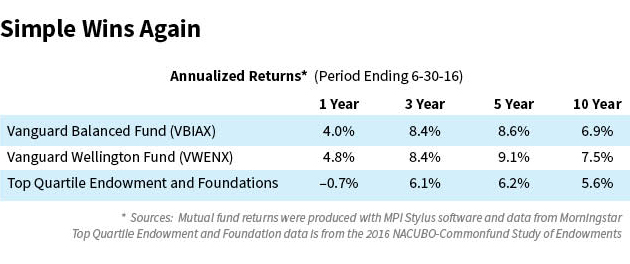
Sometimes a picture tells a thousand words. “Simple Wins Again,” below, uses the same endowment return information that we published last year. It also illustrates how two simple, low-cost Vanguard balanced funds (one index-based and one more active) continue to rank in the top quartile of U.S. endowments and foundations.
A More Complete Story

When I posted this chart on social media, like the article last year, it received some criticism. Beyond private comments from a few hedge fund and endowment-in-a-box fund of funds friends (sorry guys), one that hit home was the following: “Isn’t the story [of the chart] U.S. beats Ex-U.S.?”

This was a great point, and I publicly agreed.

Both the Vanguard Balanced Fund and the Vanguard Wellington Fund invest primarily in U.S. stocks, and the same can’t always be said for endowments and foundations. In follow-up to private comments, I also agreed that, despite their headline-making appeal, the shorter term numbers were statistically noisy.

So, in an attempt to tell a more complete story, I ran the same comparison using the simple index fund global portfolio listed in “Global Portfolio,” below, and focused on long-term results.
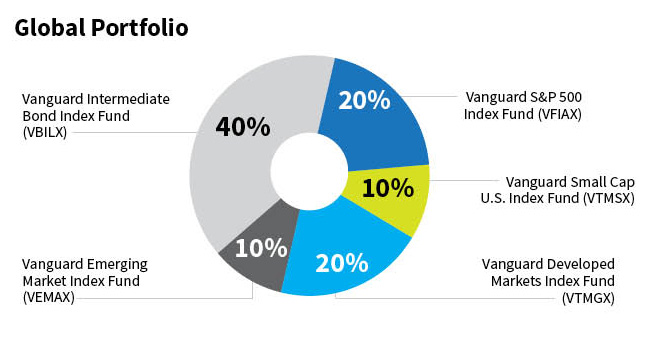
In full disclosure, this portfolio and the comparison below is more hypothetical, but it’s a portfolio that anyone could easily have implemented by buying these five index funds, then rebalancing back to the original target percentages at the end of each 12-month period.

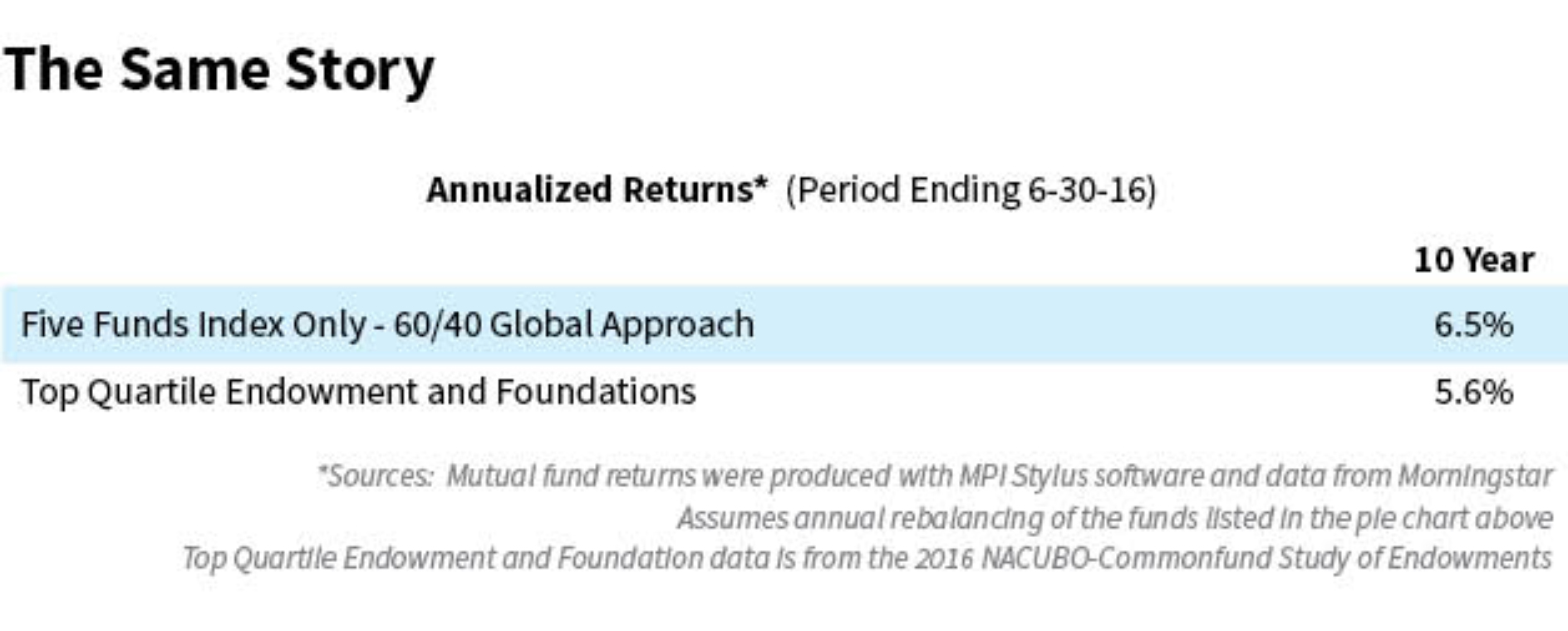
Revealingly, the story is pretty much the same as the one told by the original chart.

Even when you weight 50 percent of the equity allocation to non-U.S. stocks, a long-term 10-year period that starts at the end of a strong bull market includes one of the worst down-turns in history (2008-2009) and a more recent strong bull market recovery. The data says the following: Simple beats over 75 percent of endowments, who arguably have access to some of the brightest minds and most exclusive and complex strategies in the world. (See “The Same Story,” below.)
Yes, you could use slightly different allocations and get slightly different results, but my point is a larger one.

As I wrote about in “Are Hedge Funds Prudent for Taxable Investors?,” even though trusts and UHNW individuals aren’t endowments, I often hear Chief Investment Officers of many large private wealth management firms say things like, “To be prudent investors and good fiduciaries, it’s import to invest in an endowment-style portfolio.”

The FACTS

The point of the charts listed above are to counter claims like this, which I find often break down when you consider what my friend Wesley Gray, from Alpha Architect, calls the FACTS (below is my slightly revised take):

Fees – Incentives that are too high; often improperly aligned and too opaque.

Access – Liquidity, which can be poor and not linear. You need it when you need it and many complex strategies have significant liquidity restrictions when you need the money the most. Just ask some endowment CIOs who ran into this problem during the financial crisis and had to sell illiquid investments at fire sales prices to vulture investors.

Complexity – Many endowment-style products and models are often based on theories, which are contingent upon assumptions based on estimates. Presentations can also be hypotheticals, which may be hard to consistently implement in the real world.

Taxes – Endowments don’t pay taxes, but individuals and trusts do. As an example of the problem, many hedge fund strategies generate the majority of their returns in the form of ordinary income and short-term capital gains, which may cut returns for UHNW investors by 50 percent.

Search – How do you find the hot new manager at the correct time? Is that manager closed when you do find him? How do you properly monitor the strategies when his models, holdings and even performance are relatively opaque?

Along these lines, but moving more specifically to private equity—which is the old, yet new thing again—the president of a UHNW private client consulting firm was recently quoted as saying: “Private investments really are a need-to-do, not a nice-to-do,”

This was said even in the face of more and more research suggesting that any “advantage may have disappeared as the private equity industry [has become] more competitive.” Simple small-cap value index strategies have similar characteristics, but represent a “large improvement in risk and liquidity adjusted returns over direct allocations to private equity funds, which charge average fees of 6 percent per year.”1

Ask Why

What should investors do?

When you hear the next “need-to-do” complex endowment model pitch, consider asking the following simple, but great question that my 9 and 11-year-old children ask me all the time:

Why?

The evidence is consistent; simple strategies often perform just as well, if not better than, many complex active endowment style strategies (in addition to last year’s article and the above charts, click here to read a similar simple beats complex story). I also suggest that simple portfolios of index funds or broad-based index exchange-traded funds have a significant advantage, especially for trusts and UHNW individuals. They are 100 percent liquid, completely transparent, low-cost, very tax-efficient, easy to consistently implement and easy for everyone (spouses, children, trustees, beneficiaries, etc.) to understand.

How do I think trusts and UHNW portfolios can do better?

As David Swensen, the Chief Investment Officer of Yale’s endowment, whose performance consistently ranks in the top quartile, said in his book, Unconventional Success, stay anchored on the following:

“A serious fiduciary with responsibility for taxable assets recognizes that only extraordinary circumstances justify deviation from a simple strategy…”


Endnotes

  1. www.etf.com/sections/index-investor-corner/swedroe-private-equity-puzzle; https://papers.ssrn.com/sol3/papers.cfm?abstract_id=2720479 (see abstract)

Return Data Sources: NACUBO-Commonfund Study of Endowments and Foundations (NCSE) and Morningstar

Preston McSwain
+ postsBio
  • Preston McSwain
    Better Ways to Invest in Bonds?
  • Preston McSwain
    The Difference Simple Alternatives Can Make – 15 for 15
  • Preston McSwain
    Emerging Markets – Is the Juice Worth the Squeeze?
  • Preston McSwain
    The Road Less Traveled – Simple Alternatives
  • Preston McSwain
    Beware of Sharpe Objects
  • Preston McSwain
    The Certain Drag on Performance – Taxes
  • Preston McSwain
    Will the Real Alphas Stand Up?
  • Preston McSwain
    Is Top Manager Performance A Random Walk?
  • Preston McSwain
    Questioning the Illiquidity Premium
  • Preston McSwain
    Staying Disciplined and Avoiding Unforced Errors
  • Preston McSwain
    Still Keeping A Steady Hand
  • Preston McSwain
    Smaller Is Better
  • Preston McSwain
    Recessions – What Should Investors Do?
  • Preston McSwain
    What To Do About Inversions
  • Preston McSwain
    The Normal Steady Hand
  • Preston McSwain
    Solutions to Increase Trust – Simple But No Simpler
  • Preston McSwain
    Perspectives of a Trillion Dollar Investor – Our Conversation with Richard Ennis
  • Preston McSwain
    Trillions – Our Talk With Robin Wigglesworth About Index Funds
  • Preston McSwain
    Should We Be Tactical?
  • Preston McSwain
    It’s All Greek to Me
  • Preston McSwain
    The Same Thing – Over and Over
  • Preston McSwain
    Stats About Statistics
  • Preston McSwain
    Inflation – What Should An Investor Do?
  • Preston McSwain
    Waving Banners – Have Some ESG Managers Lost Their Way?
  • Preston McSwain
    Do The Kingmakers Have Clothes?
  • Preston McSwain
    Private Investment Questions and Issues to Consider
  • Preston McSwain
    Is Smart Beta Smart?
  • Preston McSwain
    The Simple Alternative
  • Preston McSwain
    Don’t Get Sacked – Super Bowl Version LV
  • Preston McSwain
    How to Actively Add Value
  • Preston McSwain
    What Needs to Change?
  • Preston McSwain
    Don’t Put Yourself in a Corner
  • Preston McSwain
    Trillions of Influence
  • Preston McSwain
    What Should Investors Do?
  • Preston McSwain
    Do You Need to Join the Endowment Club?
  • Preston McSwain
    Don’t Get Sacked – Super Bowl Version LIV
  • Preston McSwain
    Relative Alpha®
  • Preston McSwain
    Bungled Benchmarking
  • Preston McSwain
    Do Index Funds Make Active Funds Better?
  • Preston McSwain
    The Triumph of Hope Over Experience?
  • Preston McSwain
    Fallible Forecasts?
  • Preston McSwain
    Cash Flow – Nothing More
  • Preston McSwain
    Every Year Can Not Be Good
  • Preston McSwain
    Are We Baking Portfolios with Bad Ingredients?
  • Preston McSwain
    Private Equity Access: Do We Need More or Should We Beware?
  • Preston McSwain
    21 Tips On How To Evaluate An Investment Adviser
  • Preston McSwain
    Outperformance in Down Markets 100% of the Time?
  • Preston McSwain
    Holiday Colors
  • Preston McSwain
    Private Persistence That Just Ain’t So?
  • Preston McSwain
    The Good Lehman Brothers Story
  • Preston McSwain
    Who Is Passive?
  • Preston McSwain
    What Is Active?
  • Preston McSwain
    Why We Don’t Make Forecasts
  • Preston McSwain
    The Normal
  • Preston McSwain
    You Can Keep It Simple
  • Preston McSwain
    Where Are Fees and Expenses Not Costs?
  • Preston McSwain
    Private Presentations: Are Some Tall Tales?
  • Preston McSwain
    How Trustees Can Be Prudently Passive
  • Preston McSwain
    Ignoring Fees Doesn’t Beat the Market
  • Preston McSwain
    Trust and Fiduciary Services: Questions to Consider
  • Preston McSwain
    How Should You Invest Now?
  • Preston McSwain
    What Should Investors Do Now About…. ?
  • Preston McSwain
    Why Do Warren’s Words Carry Weight?
  • Preston McSwain
    Can I Do Better?
  • Preston McSwain
    Chicken Fried & Cold Beer On A Friday Night
  • Preston McSwain
    Don’t Let Your Portfolio Get Sacked
  • Preston McSwain
    Our Daily Groundhog Day?
  • Preston McSwain
    Talking Heads
  • Preston McSwain
    Your Brain On The Market
  • Preston McSwain
    Absolute Value and Transparency
  • Preston McSwain
    What’s In A Name?
  • Preston McSwain
    Are Hedge Funds Prudent for Taxable Investors?
  • Preston McSwain
    Keep A Steady Hand On The Tiller
  • Preston McSwain
    Pavlov’s Brokers?
  • Preston McSwain
    Is Bad For Business Sometimes Good?
  • Preston McSwain
    Say It Ain’t So, Joe
  • Preston McSwain
    Rock Science
  • Preston McSwain
    Don’t Be A Sheep
  • Preston McSwain
    No Crystal Balls – Just Peace Of Mind
  • Preston McSwain
    What Would Yale Do If It Was Taxable?
  • Preston McSwain
    Say It Ain’t So, Joe
  • Preston McSwain
    Is Trying to Pick Active Managers a Loser’s Game?
  • Preston McSwain
    If We Had A Chief Economist We Would Have to Pay Them
  • Preston McSwain
    Fiduciary Wealth Partners Reading List
  • Preston McSwain
    Transparency, Simplicity and Peace of Mind®
SHARE
Tags:
Trustees, Trusts & Estates, ultra high net worth individuals
RELATED ARTICLES
The Difference Simple Alternatives Can Make – 15 for 15
Simple portfolios consistently outperform the complex.
The Road Less Traveled – Simple Alternatives
A different type of edge – a simple investment alternative.
Are Most Investment Managers One Hit Wonders?
As someone who is about to continue my studies in the hopes of having a rewarding job in Finance, the data is unsettling.
All articles

Follow us on social media

Search Our Ideas

Subscribe to Our Posts


Important disclosures

Most Popular

  • Questioning the Illiquidity Premium
  • Say It Ain’t So, Joe
  • The Simple Alternative
  • Crucial Elements in Wealth Management: Simplicity and Transparency
  • Are We Baking Portfolios with Bad Ingredients?

Browse by Theme

  • Fees
  • Fiduciary Duty
  • Investment Philosophy
  • Managing The Market
  • Peace of Mind
  • Performance Measurement
  • Private Investing
  • Quarterly Letter
  • Simplicity
  • Taxes
  • Transparency
  • Uncategorized
  • Values

FWP Logo Dark

Fiduciary Wealth Partners is a 100% employee owned firm that serves clients in a transparent, fiduciary manner.

We do not have any fee sharing arrangements with managers and do not have any broker-dealer conflicts. In addition, you will never see an arbitration clause in our contracts.

Everything we do is focused on assisting trustees, institutions and families with investment consulting, management and overall asset planning strategies.

  • Disclosures
  • ADV
  • Privacy Policy
  • Form CRS

Useful Links

  • Investment Advisory Services
  • Wealth Counseling
  • Our Team
  • Research Roundtable
  • Our Values
  • Questions To Consider
  • Insights and Ideas
  • Contact Us

Contact us

Phone

(617) 602-1900

Email

info@fwpwealth.com

Address

2310 Washington Street
3rd Floor
Newton, MA 02462


View larger map

© 2020 FWP. All Rights Reserved. Fiduciary Wealth Partners Is An SEC Registered Investment Adviser.